
Monday, April 22, 2024

Sunday, April 21, 2024
Friday, April 19, 2024
A Draft Manifesto of the Suburban Romantics
It's been a long-standing ambition of mine to be part of a poetry school (by which I mean, a movement or group such as the Lake Poets, the Pylon Poets, or the Fireside Poets).
I even I had an extended jeu-d'esprit on this blog regarding the Unicorn School of Poetry, which was really just a daydream.
Well, I've finally come up with a serious idea for such a school, and a name for it: Suburban Romanticism. And here is a draft manifesto, which I wrote in collaboration with Dominic N of the Some Definite Service blog.
Suggestions and input are welcome, and anyone wanting to join in this nascent or (pre-nascent) movement is very welcome.
Of course, whenever I write about poetry, I brace myself for the deafening silence. But what can you do? (To be fair, I shared this manifesto on Facebook and, to my surprise and pleasure, there were a few comments.)

1) The Suburban Romantics are on the side of life.
2) The Suburban Romantics favour all the poetic conventions that were the poet's stock-in-trade up to the day before yesterday, especially rhyme and metre.
3) The Suburban Romantics believe that traditional poetic forms (such as blank verse, the sonnet, the ode, the villanelle etc.) are just as valid in the twenty-first century as they were in the seventeenth, eighteenth or nineteenth centuries.
4) The Suburban Romantics do not agree with Thoreau that “the mass of men live lives of quiet desperation”, or with Wilde that “most people exist, that is all”. We celebrate the routine, the ordinary, the workaday, the familiar.
5) The Suburban Romantics are not afraid of sentimentality or nostalgia, nor are we afraid of challenging or subverting sentimentality or nostalgia.
6) The Suburban Romantics do not genuflect before any transitory socio-political orthodoxies.
7) The Suburban Romantics want to evoke mystery, not practice mystification.
8) The Suburban Romantics are nourished at the wells of myth, legend, archetype, the sacred, the proverbial, the folkloric, the sacramental, and so on.
9) The Suburban Romantics do not disdain the topical, the ephemeral, the colloquial, the commercial, and so on.
10) The Suburban Romantics accept that the great majority of people (and perhaps an ever-increasing majority) are destined to live in suburbs, conurbations, commuter towns, housing estates, and so on. We insist that these can be the subject and setting of poetry; not just the poetry of satire and protest, but the poetry of affirmation and celebration as well. We seek the re-enchantment of the world, the transfiguration of the commonplace.
11) The Suburban Romantics have a special respect for Philip Larkin and John Betjeman, who demonstrated beyond all doubt that traditional forms can be used to explore contemporary life.
12) The Suburban Romantics are quite willing to use irony, but not to live in it as our natural element.
13) Suburban Romanticism is not a straitjacket. We do not preclude forays into free verse, rural themes, bleakness, misanthropy, obscurity, or any of the things against which this manifesto is a riposte. But they should be the exception, not the rule.
Friday, April 5, 2024
Not-So-Vital Statistics
Encouraged by an archivist friend, I've recently made back-up copies of everything I've ever posted on this blog. It was a big undertaking.
It meant that I could finally count how many words I've actually written here. I've long wondered about this, but as far as I can see, you can't get this information from Blogger's software.
Well, here goes. Up to my last post, I had written 1,503,723 words on this blog.
I was rather surprised the wordcount wasn't considerably higher.
As for other statistics: I've published 1,962 posts, I've had 4,305 comments (thank you), and I've had 974,995 pageviews (go raibh maith agat).
Sometimes I feel a bit disconsolate at how "niche" this blog has remained. However, I remind myself that it's possibly more widely read than I can tell from comments. I was engaged in some library-related correspondence with an academic in America, some months ago, and was surprised when he recognised my name from this blog, which he told me he'd read in the past. A handful of times, down the years, students in UCD have recognised me from the blog. So I take encouragement from that.
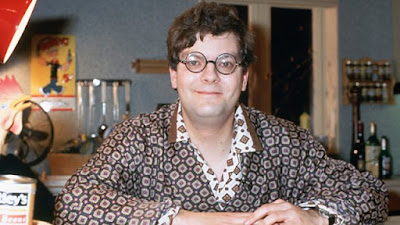
(The picture is Angus Loughran or "Statto", the resident statistician from the 1990's TV show Fantasy Football League.)
It meant that I could finally count how many words I've actually written here. I've long wondered about this, but as far as I can see, you can't get this information from Blogger's software.
Well, here goes. Up to my last post, I had written 1,503,723 words on this blog.
I was rather surprised the wordcount wasn't considerably higher.
As for other statistics: I've published 1,962 posts, I've had 4,305 comments (thank you), and I've had 974,995 pageviews (go raibh maith agat).
Sometimes I feel a bit disconsolate at how "niche" this blog has remained. However, I remind myself that it's possibly more widely read than I can tell from comments. I was engaged in some library-related correspondence with an academic in America, some months ago, and was surprised when he recognised my name from this blog, which he told me he'd read in the past. A handful of times, down the years, students in UCD have recognised me from the blog. So I take encouragement from that.
(The picture is Angus Loughran or "Statto", the resident statistician from the 1990's TV show Fantasy Football League.)

Wednesday, April 3, 2024
The Comics
It occurred to me today that I'd never written about comics, and the role of comics in my own childhood. I've touched on it, but I've never dedicated a whole post to it. This strikes me as extraordinary, given how important comics were to me.
I can't remember when exactly I started reading comics (on a weekly basis), or when I stopped, but I'm guessing it would be from around the age of nine or ten, up until well into my mid-teens.

I read British comics. There were no Irish comics. (There still aren't, as far as I know.) I think these British comics fuelled my anglophilia, they had a very British (and more specifically English) flavour. I'm sure that they used to feature Guy Fawkes cut-out masks in early November.
British comics were very different from American comic-books. They weren't as reliant on superheroes; in fact, they didn't really feature superheroes at all. They didn't have the complex mythology and backstory which American comics had been accumulating for decades.
Thursday was comic day. How fondly I remember it! It was the highlight of the week. I would buy my comics in a newsagent called Miss Mary's, where they would be kept in a box of reserved comics and magazines, always with Kelly scribbled on an upper corner. I would get them while doing the shopping with my mother, and I would be so eager to get stuck into them that I would read them as I followed my mother through the supermarket aisles.

I always got two comics, but they changed over the years. I can't remember the sequence exactly. I'm pretty sure I began with Transformers and Battle. Transformers was based on the toy franchise of robots that transformed into vehicles, weapons, and other things. Battle was (as the title suggests) a war comic that had been going since the seventies.
One of the stories in Transformers involved time travel and was called Target: 2006. It was set twenty years in the future so I must have been reading Transformers by 1986, when I was nine.

Battle eventually merged with Eagle in 1988, and was soon absorbed by it. Eagle was actually much more to my taste; rather than war stories, it concentrated on science-fiction, horror and general adventure. Eagle was always absorbing other comics. At one point, it absorbed the legendary horror comic Scream!, which only lasted for thirteen issues (appropriately) but is very fondly remembered, all these years later. Eagle inherited some of its best stories from Scream, including The Thirteenth Floor, a pleasantly nasty story about a computer called Max which runs an apartment block...an apartment block which doesn't have a thirteenth floor, except one that strangely appears when some malefactor has to be dealt with...

Then in 1990, the Irish soccer team went to the World Cup Finals in Italy and transformed Ireland. I started reading Roy of the Rovers, a soccer comic. At some point, I transferred to a soccer magazine instead, Shoot! I suppose that was the end of my comic-reading days.
Of course, I read other comics. My older brother would sometimes read 2000 AD, a much grittier and more adult-oriented science fiction comic, which featured the famous (or infamous) Judge Dredd. So I read it, too. Its cynicism both excited and disturbed me. There was another war comic called Warlord, which I encountered in the form of annuals. (British comics would release a hard-backed annual issue every year. They still do. These were always a part of our Christmas.)

Funny comics like The Beano and The Dandy weren't really a part of my childhood. I would have seen those as baby stuff. I only knew them through annuals. (I came across a lot of annuals in sales of work, or jumble sales, or whatever you call such events-- there seems to be an extraordinary number of different names for them.)
Although Transformers was a British comic, it was set in America-- Oregon, for the most part, where the Transformers landed when they fled their home planet of Cybertron. Transformers was mostly written by a chap called Simon Furman, and he didn't write down to his juvenile readers. I'm convinced that the comic had a beneficial effect on my vocabulary, as Furman frequently used "grown-up" words in his stories. They weren't very cartoony and they were often quite dark.
They were smart, too. For instance, one story involved one of the Transformers going back in time and getting killed in the past. Letter-writers to the comic pointed out that the character was now stuck in a time-loop. I think this was the first time I encountered a time-loop in fiction, a concept that has never ceased to fascinate me, especially in my favourite film Groundhog Day.
Readers' letters appeared on a letters page where they were answered by one of the Transformers, usually in a humorous manner. When I started reading t it was Grimlock, the leader of the Dinobots-- robots that transformed into, you guessed it, dinosaurs. The letters page was called Grim Grams. I owned the toy version of Grimlock-- he was one of my favourites.
(I could write a separate blog post about Transformers toys, and I might well do so some day. They were my favourite toy as a child, and I collected them avidly. I feel a bit guilty about just how materialistic I was when it came to Transformers. I still have dreams (literal sleepy-time dreams) of owning a complete set of Transformers-- which would, of course, be impossible, as new models are always being released, even still. One of the reasons I liked Transformers was that adults were impressed by them. My sister's friends, in their late teens and early twenties, used to enjoy transforming my Transformers during parties, absent-mindedly, as they chatted about whatever they chatted about. Grown-ups often declared: "They're really clever toys", which gave me a sense of pride. My collection would probably be worth a fortune, except that it was filched by my nephews and nieces without me realizing it. I never kept them in good condition, anyway.)

In fact, one of my favourite things about the Transformers comic was all the editorial content. There was always a sort of prologue on the first page, and a "sneak preview" of the next issue on the back page, as well as the letters page. It gave the whole thing a clubbish atmosphere. I especially liked the sneak-preview; it always showed one image from the next issue, surrounded by a frame of circuitry. This aroused my love of frames, a love that was shared so intensely by G.K. Chesterton that it's the entry-point of his autobiography. I write about this idea here.
I'm having far too much fun writing this post, and I could probably keep it up forever. So, instead of describing each comic in detail, I'll skip to the stories that I liked (and disliked) in each comic.
The most famous comic-strip in The Eagle was Dan Dare, Pilot of the Future. It was a science-fiction story, a sort of Biggles in space. When I started reading The Eagle, it wasn't the original Dan Dare (the story had actually begun in the fifties), but rather a descendant. However, I hadn't been reading it too long when they went back to the original Dan Dare, with a sort of steampunk flavour-- the artwork was extraordinarily good. But I never really liked Dan Dare much, although I did like his arch-enemy the Mekon-- a green, bald creature who floated around on a flying saucer.

Eagle also had a science-fiction/horror strip called Doomlord, about an alien who comes to Earth to judge it and destroy it. He subsequently changes his mind and tries to defend it from his own race. Doomlord was a pleasingly dark serial, and the alien himself had an impressively scary appearance. (It began as a photo-strip, before I started reading it, then became a drawn strip by the time I came along.)

But my favourite Eagle story had to be Computer Warrior. This featured a kid called Bobby Patterson playing computer games for real-- as an actual character in the games. His friend had been captured in the computer and he had to free him by winning a series of games. The realm in which all this was taking place was called The Nightmare Zone, presided over by a Warlord. Bobby Patterson himself eventually became a Warlord.
I've always been a sucker for anything involving different levels of reality, and Computer Warrior might have been one of my first encounters with this sort of story. It was also typical of the eighties' fascination with computers. They weren't a part of everyday life yet, but they certainly loomed large in the collective imagination.

The Eagle comic grew more cynical as the eighties wore on, whether that reflected the zeitgeiest or the presumed increasing maturity of its readers. In 1989, it began to run the story Toys of Doom, in which a rather obnoxious teenager finds a remote-controlled army of toys created by his late grandfather. They might have only been toys, but they could cause real trouble, and provide real protection-- or revenge! The premise was wonderful-- which kid wouldn't love to have such an army? And, even though Nicholas Jardine was a brat, you rooted for him because other kids and adults always seemed to be picking on him.

Comics at this time were full of stories which promoted toy lines, but Eagle featured a rather strange twist on this phenomenon-- Storm Force looked as though it promoted a range of toys, but it didn't. It came about when Eagle (or was it Battle?) lost the license to run stories based on the Action Force toy range. So they came up with a substitute, which was Storm Force. It featured a group of elite mercenaries, led by a square-jawed action hero called John Storm, who had a gun in the place of a missing arm. They included a Scottish ninja (ninjas were big in the eighties), a guy with an "exo-skeleton" which gave him immense strength, a nerdy kid who knew all about guns and computers, and (this was the most original character) a chap called Porcupine, who wore a suit made of knives which rose up when he was angry, or ready for battle, or something. Storm Force was pretty good. Readers even got to asking when Storm Force action figures would become available, but they never did.

Is anyone still reading? I could go on all day. Perhaps some people who loved these comics back in the day will come upon this post. Just writing it brings me back to that far-off, strange country, the eighties. I remember reading my comics as I ate my favourite snack-- three sausages rolled up in buttered pieces of bread, like hot dogs. (I'd never had a hot dog, as far as I remember.) I can almost hear the melted butter dripping onto the pages.
I don't read comics anymore. As unfashionable as it might be these days, I do tend to think that comics are for kids-- for dipping into nostalgically now and again, perhaps, but not really suitable reading for adults. The whole idea of "graphic novels" is very unappealing to me. But perhaps I am narrow-minded.
It's interesting to me that these comics have left a very faint popular culture imprint. You can find a few websites dedicated to the Eagle and other titles, but I never (or extremely rarely) hear about them unless I go looking. It's a huge contrast to American comics, Batman and Spiderman and all the others being familiar to everybody. None of the kids I knew read comics, and certainly not the comics that I read.
One more thing. I can remember coming across a girl's comic once, when I was on holiday on my aunt's farm in Limerick. I don't know where it came from. I remember it featured one story set in Tibet (or some Tibet-like mountainous country), which involved magical holy men, and an avalanche set off by noise.
Ridiculous as it sounds, never in my life was I struck by the delicious and shocking otherness of the feminine as I was when I read this comic. I'd never suspected there was such a thing as a girl's comic. It was just like a boy's comic...except completely different! I think the paper was even pink (or maybe orange). No experience in my life, including those involving actual flesh-and-blood women, has ever startled me so much with the strangeness of sex and sex difference. I think it was the sudden awareness of female subjectivity, that girls had their own adventures and heroines and imaginary worlds, that did it. Perhaps the setting of the Tibetan mountains added to the sense of discovery and exoticism.
And then there is my dream of Legacy, and the Snow Issue of Transformers...but I have to end somewhere...
Thursday, March 28, 2024
Happy Easter!
I won't get another chance to blog over the Triduum, so I wish you all a happy Easter.
As I've often said on this blog, I love special times and seasons. And which is more special than Easter? Indeed, it surpasses the capacity of human language.
In the lives of the saints and visionaries, we see ample proof that God takes the liturgical calendar very seriously. For instance, the death of St. Gemma Galgani seems to mirror Christ's Passion in a very mysterious way.
Going with my recent practice, I've tried to change the blog's theme to gold and white (which will sadly be incongruous with the sombre nature of Good Friday), but I can't seem to work out how to change the colour of the blog post titles this time. Oh well.

Tuesday, March 26, 2024
Letters to Malcolm
I remember reading an Amazon review of C.S. Lewis's Letters to Malcolm, Chiefly on Prayer which confidently asserted that the "Malcolm" of the title was Malcolm Muggeridge, the English journalist and writer who became an outspoken Christian in his later life. (It's still up.)
This isn't true, of course. The Malcolm to whom Lewis was writing was imaginary. But just yesterday I came across a book which is full of letters to Malcolm Muggeridge. It's called Searching for God in Britain and Beyond: Reading Letters to Malcolm Muggeridge, 1966–1982. The author is David G. Reagles (what makes someone decide to use their middle initial, incidentally?).

It draws on the thousands of fan letters that Malcolm Muggeridge received for his religious writing. Unlike some authors, Muggeridge was very appreciative of this fan mail, and very responsive to his readers; not only writing back, but even sending them copies of his books, and meeting with them in person. He kept the letters in the hope that someone would write a book such as this one.
Muggeridge is a strange case. He has nothing like the stature of C.S. Lewis or G.K. Chesterton, perhaps because he was unwilling to engage in traditional apologetics. I rarely hear anybody quote him, even conservative Christians. Nevertheless he seems to have spoken to many people in his own time, and his resistance to the tide of liberal secularism was most courageous.
He's regularly mocked for his debate with the Monty Python crew over Life of Brian, but I think he acquitted himself very well. He was quite obviously fighting a lost battle. The Pythons' insistence that they meant no disrespect to Christianity is not terribly convincing, and even seems like a cop-out.
Despite a certain amount of academic jargon, this is a fascinating insight into the lives of British people living through the liberalization and secularization of Britain, and how they reacted to that. The letter-writers had a great deal to say about their own histories, and it's deeply interesting.
It's a pricey book, so it might not be worth actually buying first-hand. I came across the e-book on the library catalogue while looking for something else, and I've been printing chapters out to read them on my tea-breaks.
Aren't books wonderful? So many different things can make material for a book.
Subscribe to:
Posts (Atom)